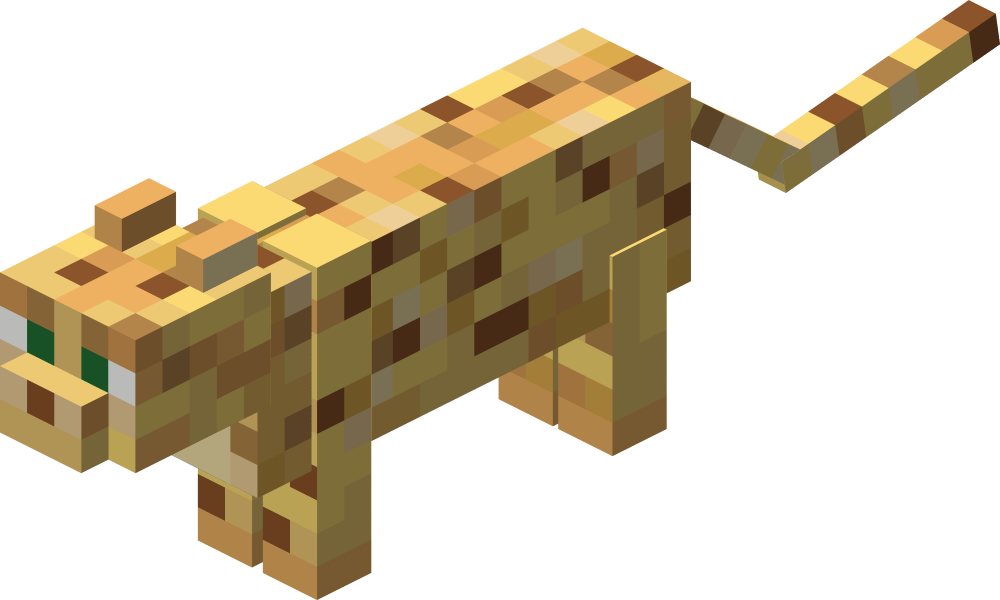
Ocelot
passiveBreedable Health
 Damage
 XP Drop
 Added In
Overview
In Minecraft, the Ocelot is classified as a passive mob — it will never attack a player and simply goes about its own behaviour.
Look for the Ocelot across the Overworld; it is tied to Jungle, Bamboo Jungle, and Sparse Jungle.
What sets it apart is its behaviour: shy, runs from players unless approached slowly while holding raw cod or salmon.
It carries 10 health points — 5 hearts — and yields 1–3 experience when it dies.
It was first added in 1.2.1 and has been a fixture of Minecraft ever since.
Also worth noting: Creepers stay 6 blocks away from ocelots.
Even without combat or loot to speak of, the Ocelot adds character to the worlds it lives in and often plays a quiet supporting role in the wider ecosystem.
Spawning
In the wild, the Ocelot is generated in Jungle, Bamboo Jungle, and Sparse Jungle.
Your best bet is to head straight for Jungle, since that is where it turns up most reliably out of the handful of biomes it favours.
Spawns on grass or leaves in Jungle biomes above Y=63.
Height matters too: these spawns are tied to around Y=63, so the vertical slice you build or explore at directly affects how many you encounter.
Because it is harmless, the Ocelot is mostly useful as a renewable source of its drops, and you can let a small population breed up over time.
Drops
Do not expect loot from the Ocelot: it has an empty drop table and yields only XP.
The value of the Ocelot is in what it does while alive — its behaviour and the role it plays in the world — rather than anything you collect by killing it, so there is little reason to hunt one for materials.
If you are after specific items, the Ocelot is not your source for them; look to mobs with populated drop tables or to mining and trading instead.
In terms of experience, each kill is worth 1–3 XP orbs.
Since there is nothing to pick up, you do not need to worry about a hopper or collection system for ocelots — they leave the ground exactly as they found it.
Because the Ocelot is harmless and breeds, the efficient long-term approach is a small enclosed pen where a breeding pair keeps replacing what you harvest, rather than hunting wild ones down one by one.
Behavior & Combat
In the field, shy, runs from players unless approached slowly while holding raw cod or salmon. Creepers and phantoms avoid ocelots.
Its 10 health is modest, falling to roughly 2 hits from a diamond sword.
Dealing zero damage, the Ocelot is one of the safest creatures to be around.
Ocelots can be bred with Raw Cod; feed it to two adults and they produce a baby that grows up over about twenty minutes.
All told, the Ocelot is a low-risk part of the world that rewards patience more than aggression.
Frequently Asked Questions about the Ocelot
How much health does a Ocelot have?
A Ocelot has 10 health points, which is 5 hearts on its health bar.
What does a Ocelot drop?
A Ocelot does not drop any items, only 1–3 experience.
Where do Ocelots spawn in Minecraft?
Ocelots spawn in Jungle, Bamboo Jungle, and Sparse Jungle. Spawns on grass or leaves in Jungle biomes above Y=63.
How do you breed Ocelots?
Ocelots are bred by feeding Raw Cod to two adults, which puts them into love mode and produces a baby Ocelot.
How much XP does a Ocelot drop?
A Ocelot drops 1 to 3 experience points when killed.
What biome is the best place to find Ocelots?
Ocelots are found in Jungle, Bamboo Jungle, and Sparse Jungle, so any of those biomes is a good place to start looking.