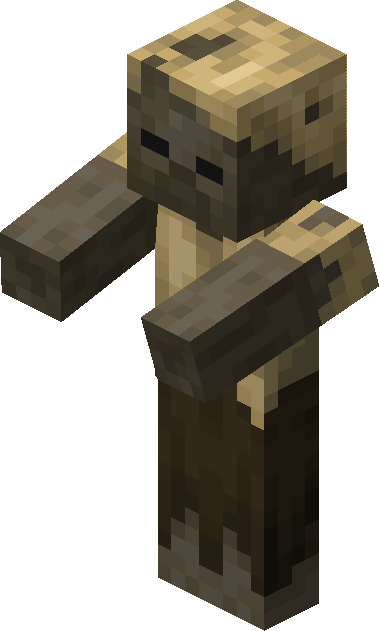
Husk
hostileOurs, not the game's own: how a husk behaves. Bedrock v1.26.40.05 differs: spawn weight 80 on Java against 240 on Bedrock; groups of 4 on Java against 2 to 4 on Bedrock. Checked 2026-08-22, and here is how we check.
 Added In
Overview
A Husk is a hostile mob: it will attack players on sight whenever it is able to reach them.
Look for the Husk across the Overworld; it is tied to Desert.
Its defining trait is simple: zombie variant that does not burn in sunlight.
With 20 HP (10 hearts) on its bar, killing one rewards 5 experience.
Players have been encountering the Husk since the 1.10 update.
One thing worth knowing: Unlike zombies, husks do not burn in sunlight.
Knowing how the Husk behaves is mostly about survival: recognising it early and reacting correctly is what keeps a night-time excursion from ending in a respawn.
Damage by Difficulty
Spawning
In the wild, the Husk is generated in Desert.
That single-biome restriction means Desert is the only place to look; if you are not there, you will not find one, so locating the biome is the real task.
Spawns at light level 0 in desert biomes on sand blocks. Replaces 80% of zombie spawns in deserts.
Pay attention to lighting: a light level of 0 is required, which is exactly what makes torch placement such an effective way to suppress or encourage these spawns.
Naturally spawned husks will despawn over time when no player is nearby; naming one with a name tag or leading it away on a lead keeps it permanent.
For a reliable Husk farm, set your spawning floor within the biomes above and light everything else nearby so spawns funnel to one spot.
Where the Husk spawns
Desert is where it stands strongest: weight 80 on the monster list and 15.5% of it, arriving 4 at a time. There it shares the list with Creeper at 100, Slime at 100, Spider at 100, Parched at 50 and Skeleton at 50 and 4 more, 515 weight together, of which 80 is husk. That is the whole list.
| Biome | Weight | Share | Group |
|---|---|---|---|
 Desert Desert | 80 | 15.5% | 4 |
Drops
Killing a Husk produces the following loot:
Nothing here is guaranteed: a kill can give you 0 to 2 Rotten Flesh, 1 Rabbit's Foot only in specific situations, 1 Iron Ingot (rarely, 2.5% chance), 1 Carrot (rarely, 2.5% chance), and 1 Potato (rarely, 2.5% chance).
You also collect 5 experience for every Husk you defeat.
Farming husks is the standard way to stockpile rotten flesh in quantity.
The Looting enchantment on your sword raises the quantity and, for many of these items, the drop chance of the rarer rolls, so it is well worth using when you grind this mob.
With nothing guaranteed, output is swingy: over many kills the averages hold, but any single Husk may give you little, so farm in volume rather than expecting a jackpot each time.
| Item | Count | Chance | Conditions |
|---|---|---|---|
| Rotten Flesh | 0 to 2 | not every kill | Looting III up to 5 |
| Rabbit's Foot | 0 to 1 | situational | Looting III up to 4 |
| Iron Ingot | 1 | 2.5% | player kill |
| Carrot | 1 | 2.5% | player kill |
| Potato | 1 | 2.5% | player kill, cooked when burnt |
 Rabbit's Foot
 Iron Ingot
 Carrot
 Potato
That Rabbit's Foot row is not its own: the rabbit drops 1.
Husk attributes
| Attribute | Value |
|---|---|
 Armour Armour | 2 points |
 Size Size | 0.6 x 1.95 blocks |
 Eye height Eye height | 1.74 blocks |
 Tracking range Tracking range | 8 chunks |
| Follow range | 35 blocks |
 Experience Experience | 5 |
 Health Health | 20 points |
 Movement speed Movement speed | 0.23 |
 Attack damage attribute Attack damage attribute | 3 |
The Husk does not stand alone on these numbers: the drowned on the same 35 follow range.
Husk: 0.23% of its category, rank 46 of 52
On 1 of the 66 biome lists (1 spawn entry in total), and 0.23% of every spawn the game puts in its monster group is a husk.
64 husk kills fill a stack of 64 Rotten Flesh, because the ranges Minecraft Java 26.2 rolls for it come out at 1 per kill before Looting. Carrot runs at 0.025 a kill, 2560 husk kills for a stack of its own. 2 further rows sit under those, down to 0.025 Potato per husk and 2560 kills a stack. 3 of those 4 rows (Carrot, Iron Ingot, and Potato) only roll when a player lands the killing blow, so a husk killed by a fall or another mob averages 1 item instead of 1.075.
| Item | Average per kill |
|---|---|
 Rotten Flesh Rotten Flesh | 1 |
4 situational rows left out. How this average is worked out
| Weapon | Attack damage | Full swings | Swings per 64 Rotten Flesh |
|---|---|---|---|
 golden sword, golden sword, wooden sword wooden sword | 4 | 6 | 384 |
 stone sword stone sword | 5 | 5 | 320 |
| iron sword | 6 | 4 | 256 |
 diamond sword, diamond sword, golden axe, golden axe, wooden axe wooden axe | 7 | 4 | 256 |
 netherite sword netherite sword | 8 | 3 | 192 |
 diamond axe, diamond axe, iron axe, iron axe, stone axe stone axe | 9 | 3 | 192 |
 netherite axe netherite axe | 10 | 3 | 192 |
The 2 armour points on a husk are already in that column: they cut a 4 damage swing to 3.68, worth 1 extra swing at the cheap end, and 3 rather than 2 at the expensive one. Coming the other way, a husk hit is 15% of a player's 20 health, 7 of them a full bar, all out of the husk's 3 damage on Normal. On Easy the same husk hit is 10%, on Hard 20%, so 10 hits against 5. The zombie and zombie villager match every number above, health, attack and yield alike, so the number of rows the game rolls for them is the honest way to tell a husk apart: 5 rows here against 6 rows for the zombie and 4 rows for the zombie villager, counted over those rows themselves.
Behavior & Combat
In the field, zombie variant that does not burn in sunlight. Inflicts Hunger effect on attack. Converts to zombie if submerged in water.
It is one of the few mobs that wears armour: 2 points, which takes about 8% off every hit it receives.
Its combat profile is 20 health (10 hearts) with attacks dealing 2 on Easy, 3 on Normal and 4 on Hard.
When fighting back, remember it is weak to Smite enchantment and Healing splash potions.
A sword enchanted with Smite shortens the fight considerably against this mob.
Daylight is no help against this one, but the undead rule still is: the Healing splash potions its own weakness list names damage it, a Potion of Harming would heal it, and the 2 armour points it wears do nothing about either one.
The practical takeaway is to respect its strengths, exploit the weaknesses listed above, and you will rarely lose a fight you choose to take.
Husk commands
| Command | What it does |
|---|---|
| /summon minecraft:husk | Puts a husk on the block you are standing on. |
| /give @p minecraft:husk_spawn_egg | Hands you the husk spawn egg, so you can place husks where you want them. |
| /kill @e[type=minecraft:husk] | Removes every husk that is loaded around you. |
Entity id minecraft:husk, spawn egg minecraft:husk_spawn_egg.
Husk farm
Everything about a husk farm follows the husk spawn rule. Spawns at light level 0 in desert biomes on sand blocks. Replaces 80% of zombie spawns in deserts.
Of the 1 biome spawn list the husk stands on, Desert gives the husk its largest share at 15.5%, so a husk platform there fills faster than the same build anywhere else.
The game puts 4 husks down per roll, so a wide husk floor beats a tall one.
Each kill is worth 5 experience and up to 2 rotten flesh, or 5 with Looting III, and that figure is what decides how big the husk farm has to be.
Husk version history
8 June 2016 is the day the husk arrived, in Minecraft 1.10, and the husk has been part of the game for 10 years since.
2 other mobs here came with it: the polar bear and the stray. Of the 88 mobs we list, 39 were in the game before the husk and 46 arrived after it.
The husk numbers here come from Java 26.2, the version running now, and not from the one that introduced it.
What Husk sounds like
Turn subtitles on and every husk sound names itself in the corner of the screen. These are the 4 lines a husk can put there, and you can play any of them yourself with /playsound minecraft:entity.husk.ambient master @p.
| Sound | What you hear |
|---|---|
| entity.husk.ambient |  Husk groans Husk groans |
| entity.husk.hurt | Husk hurts |
| entity.husk.death | Husk dies |
| entity.husk.converted_to_zombie | Husk converts to Zombie |
Advancements that need Husk
2 advancements ask for husk by name, and each of them counts other mobs too.
- Monster HunterKill any hostile monster
- Monsters HuntedKill one of every hostile monster
